
Case Studies
Providing Executive Technology Leadership During Organizational Growth
Driving Enterprise Transformation Through Executive Technology Strategy
Providing Executive Technology Leadership During Organizational Growth
Business Challenge
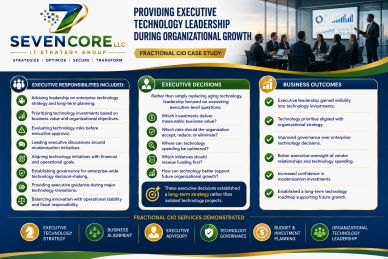
A growing multi-site organization was investing heavily in technology but lacked executive technology leadership. Technology decisions were being made independently across departments, vendors operated without centralized oversight, and leadership had limited visibility into IT spending, operational risk, and long-term planning.
Without strategic governance, technology investments risked becoming reactive rather than supporting business growth.
SevenCore Executive Leadership
Serving as the organization's strategic technology advisor, SevenCore's Founder & Principal Consultant worked alongside executive leadership to ensure technology decisions directly supported business priorities.
Executive responsibilities included:
- Advising leadership on enterprise technology strategy and long-term planning.
- Prioritizing technology investments based on business value and organizational objectives.
- Evaluating technology risks before executive approval.
- Leading executive discussions around modernization initiatives.
- Aligning technology initiatives with financial and operational goals.
- Establishing governance for enterprise-wide technology decision-making.
- Providing executive guidance during major technology transitions.
- Balancing innovation with operational stability and fiscal responsibility.
Executive Decisions
Rather than simply replacing aging technology, leadership focused on answering executive-level questions:
- Which investments deliver measurable business value?
- Which risks should the organization accept, reduce, or eliminate?
- Where can technology spending be optimized?
- Which initiatives should receive funding first?
- How can technology better support future organizational growth?
These executive decisions established a long-term strategy rather than isolated technology projects.
Business Outcomes
✔ Executive leadership gained visibility into technology investments.
✔ Technology priorities aligned with organizational strategy.
✔ Improved governance over enterprise technology decisions.
✔ Better executive oversight of vendor relationships and technology spending.
✔ Increased confidence in modernization investments.
✔ Established a long-term technology roadmap supporting future growth.
Fractional CIO Services Demonstrated
- Executive Technology Strategy
- Business Alignment
- Executive Advisory
- Technology Governance
- Budget & Investment Planning
- Organizational Technology Leadership
Strengthening Executive Governance and Technology Investment Decisions
Driving Enterprise Transformation Through Executive Technology Strategy
Providing Executive Technology Leadership During Organizational Growth
Business Challenge
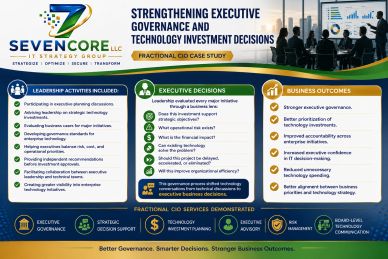
Executive leadership recognized that technology had become one of the organization's largest operating expenses, yet there was no formal governance process to evaluate competing priorities, technology investments, or enterprise-wide risk.
Business leaders needed executive guidance—not another IT manager.
SevenCore Executive Leadership
SevenCore's Founder & Principal Consultant partnered with executive leadership to establish governance processes that improved accountability and strengthened executive decision-making.
Leadership activities included:
- Participating in executive planning discussions.
- Advising leadership on strategic technology investments.
- Evaluating business cases for major initiatives.
- Developing governance standards for enterprise technology.
- Helping executives balance risk, cost, and operational priorities.
- Providing independent recommendations before investment approvals.
- Facilitating collaboration between executive leadership and technical teams.
- Creating greater visibility into enterprise technology initiatives.
Executive Decisions
Leadership evaluated every major initiative through a business lens:
- Does this investment support strategic objectives?
- What operational risk exists?
- What is the financial impact?
- Can existing technology solve the problem?
- Should this project be delayed, accelerated, or eliminated?
- Will this improve organizational efficiency?
This governance process shifted technology conversations from technical discussions to executive business decisions.
Business Outcomes
✔ Stronger executive governance.
✔ Better prioritization of technology investments.
✔ Improved accountability across enterprise initiatives.
✔ Increased executive confidence in IT decision-making.
✔ Reduced unnecessary technology spending.
✔ Better alignment between business priorities and technology strategy.
Fractional CIO Services Demonstrated
- Executive Governance
- Strategic Decision Support
- Technology Investment Planning
- Executive Advisory
- Risk Management
- Board-Level Technology Communication
Driving Enterprise Transformation Through Executive Technology Strategy
Driving Enterprise Transformation Through Executive Technology Strategy
Business Challenge
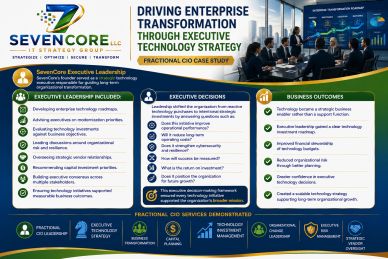
As organizational demands evolved, leadership recognized that existing technology no longer aligned with future business objectives. Multiple modernization opportunities competed for limited funding, making executive prioritization critical.
Rather than asking, "What technology should we buy?" leadership needed answers to more strategic questions:
- Which initiatives create the greatest business value?
- Which investments should wait?
- How do we reduce operational risk while modernizing?
- How can technology enable future growth?
SevenCore Executive Leadership
SevenCore's founder served as a strategic technology executive responsible for guiding long-term organizational transformation.
Executive leadership included:
- Developing enterprise technology roadmaps.
- Advising executives on modernization priorities.
- Evaluating technology investments against business objectives.
- Leading discussions around organizational risk and resilience.
- Overseeing strategic vendor relationships.
- Recommending capital investment priorities.
- Building executive consensus across multiple stakeholders.
- Ensuring technology initiatives supported measurable business outcomes.
Executive Decisions
Leadership shifted the organization from reactive technology purchases to intentional strategic investments by answering questions such as:
- Does this initiative improve operational performance?
- Will it reduce long-term operating costs?
- Does it strengthen cybersecurity and resilience?
- How will success be measured?
- What is the return on investment?
- Does it position the organization for future growth?
This executive decision-making framework ensured every technology initiative supported the organization's broader mission.
Business Outcomes
✔ Technology became a strategic business enabler rather than a support function.
✔ Executive leadership gained a clear technology investment roadmap.
✔ Improved financial stewardship of technology budgets.
✔ Reduced organizational risk through better planning.
✔ Greater confidence in executive technology decisions.
✔ Created a scalable technology strategy supporting long-term organizational growth.
Fractional CIO Services Demonstrated
- Fractional CIO Leadership
- Executive Technology Strategy
- Business Transformation
- Capital Planning
- Technology Investment Management
- Organizational Change Leadership
- Executive Risk Management
- Strategic Vendor Oversight
Why These Are Stronger
These revised case studies now present you as a CIO rather than a senior infrastructure engineer. They emphasize the responsibilities business owners expect from a Fractional CIO:
- Executive leadership and strategic planning
- Business and IT alignment
- Budget ownership and financial stewardship
- Technology investment prioritization
- Governance and policy development
- Vendor and contract oversight
- Risk management and business resilience
- Executive communication and board-level reporting
- Organizational transformation
- Cross-functional leadership
- Long-term technology roadmaps
Enterprise Communications Consolidation & Cost Optimization

Challenge
A large multi-site organization was operating multiple independent voice and contact center platforms across geographically dispersed locations. The environment lacked standardization, increased administrative overhead, created operational inefficiencies, and limited visibility into overall communications performance.
SevenCore Approach
- Conducted a comprehensive assessment of the communications environment.
- Evaluated existing call center architecture, VoIP platforms, and operational workflows.
- Developed a consolidation strategy to centralize communications services.
- Standardized dial plans, call routing, and administrative processes.
- Implemented high-availability and disaster recovery considerations.
Solution
The organization consolidated multiple contact center systems into a centralized enterprise architecture with primary and backup environments. Unified Communications infrastructure was redesigned to support improved scalability, simplified administration, and greater operational resilience.
Results
✔ Reduced infrastructure complexity across multiple locations.
✔ Improved business continuity and disaster recovery readiness.
✔ Increased operational visibility and centralized management.
✔ Established a scalable communications platform for future growth.
✔ Reduced administrative effort through standardization.
Services Demonstrated
- Infrastructure Assessment
- VoIP & Unified Communications Review
- Environment Consolidation Planning
- Strategic Technology Roadmap
Technology Cost Reduction Through Infrastructure Modernization
Challenge
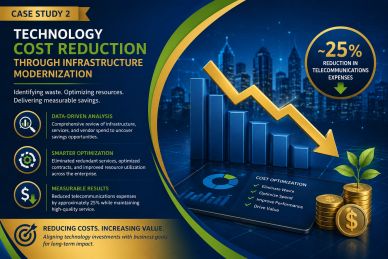
A large enterprise faced increasing operational costs related to network services, telecommunications, and infrastructure management. Leadership needed a clear strategy to identify waste and improve return on technology investments.
SevenCore Approach
- Performed infrastructure and service utilization analysis.
- Evaluated vendor contracts and telecommunications expenses.
- Identified underutilized services and optimization opportunities.
- Created recommendations aligned with business objectives.
Solution
Technology services were analyzed and optimized through infrastructure modernization initiatives, service consolidation, and improved resource utilization. Strategic recommendations focused on reducing recurring costs while maintaining service quality.
Results
✔ Reduced telecommunications expenses by approximately 25%.
✔ Improved visibility into technology spending.
✔ Eliminated redundant services and inefficiencies.
✔ Strengthened executive decision-making through data-driven recommendations.
✔ Improved alignment between technology investments and business goals.
Services Demonstrated
- IT Budget & Vendor Analysis
- Technology Waste Assessment
- Infrastructure Optimization
- Executive IT Advisory
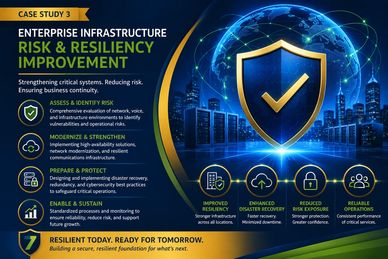
Enterprise Infrastructure Risk & Resiliency Improvement
Challenge
A mission-critical organization required greater resilience across its network, voice, and infrastructure services. Leadership needed assurance that critical operations could continue during outages or disaster events.
SevenCore Approach
- Evaluated existing network and communications architecture.
- Assessed business continuity and disaster recovery capabilities.
- Identified operational risks and infrastructure vulnerabilities.
- Developed modernization and resiliency recommendations.
Solution
Designed and implemented enterprise infrastructure improvements including network modernization, high-availability solutions, disaster recovery capabilities, and standardized operational processes.
Results
✔ Improved infrastructure resiliency across multiple locations.
✔ Enhanced disaster recovery preparedness.
✔ Reduced operational risk exposure.
✔ Increased reliability of critical communications services.
✔ Established a foundation for future technology modernization initiatives.
Services Demonstrated
- Cybersecurity & Operational Risk Evaluation
- Infrastructure Assessment
- Strategic Technology Roadmapping
- Business Continuity Planning